Last update:
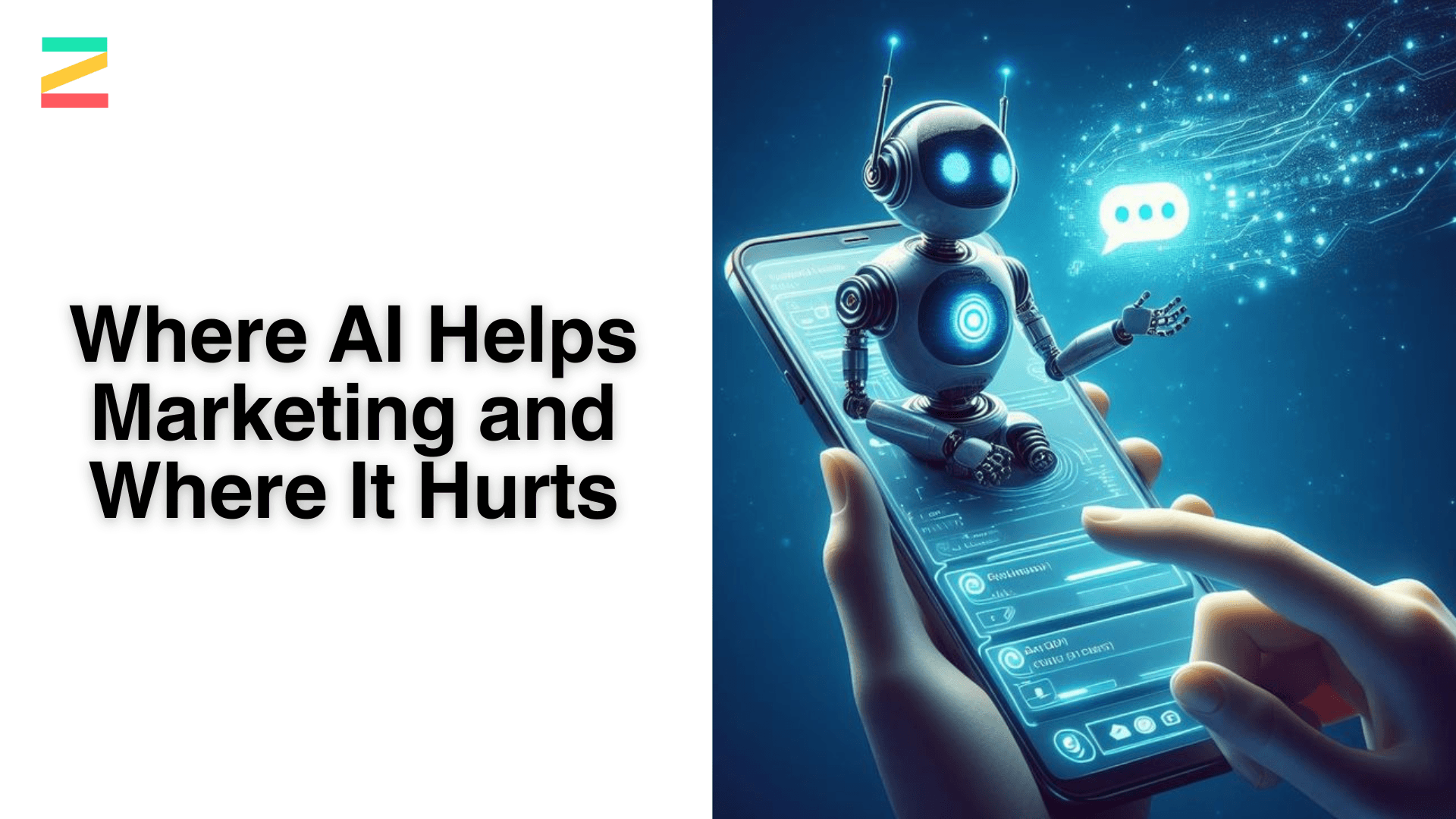
Artificial Intelligence is no longer a future concept in marketing. It’s here, deeply integrated into how brands create content, analyze data, run campaigns, and communicate with customers. From automated ad targeting to AI-generated creatives, marketers today have access to tools that can work faster than any human team ever could.
But speed doesn’t always mean success.
While AI can significantly improve efficiency and scalability, it can also damage brand trust, creativity, and customer relationships when used blindly. The real challenge for modern marketers isn’t whether to use AI it’s knowing where AI adds value and where human intelligence must remain in control.
In this article, we explore where AI truly helps marketing and where it quietly hurts it.
Where AI Helps Marketing
1. Data Analysis and Insights at Scale
One of AI’s biggest strengths is its ability to process massive amounts of data quickly. Modern marketing generates data from websites, social media, ads, emails, CRM systems, and more. Analyzing this manually is not just slow it’s nearly impossible.
AI tools can:
Identify patterns in customer behavior
Predict future trends based on historical data
Segment audiences more accurately
Highlight opportunities humans might miss
This allows marketers to make data-driven decisions instead of relying on assumptions. When used correctly, AI transforms raw data into actionable insights that improve targeting, timing, and messaging.
2. Smarter Ad Targeting and Optimization
AI has revolutionized paid advertising. Platforms like Google and Meta use machine learning to optimize campaigns in real time based on performance signals.
AI helps by:
Automatically adjusting bids for better ROI
Identifying high-intent audiences
Optimizing ad placements and formats
Reducing wasted ad spend
Instead of manually tweaking campaigns every day, marketers can focus on strategy and creative direction, while AI handles continuous optimization in the background.
3. Faster Content Production (With Limits)
AI has become a powerful assistant for content teams. It can generate outlines, draft copies, suggest headlines, and repurpose content across formats.
Used responsibly, AI helps:
Speed up content workflows
Overcome writer’s block
Maintain publishing consistency
Support SEO research and structure
This is especially useful for scaling blogs, emails, landing pages, and social content. However, AI should support content creation not replace human storytelling, tone, and emotional depth.
4. Personalization at Scale
Personalization is no longer optional in marketing. Customers expect brands to understand their needs and preferences. AI enables personalization at a level that manual efforts cannot achieve.
AI can:
Recommend products based on user behavior
Customize email content and subject lines
Personalize website experiences dynamically
Predict what users are likely to engage with next
When done right, personalization increases engagement, conversions, and loyalty without making customers feel like they’re interacting with a machine.
5. Marketing Automation and Efficiency
AI-powered automation saves time and reduces human error. From chatbots to automated email workflows, AI allows brands to respond faster and operate more efficiently.
Key benefits include:
24/7 customer support through chatbots
Automated lead nurturing
Faster response times
Consistent customer interactions
This frees up marketing teams to focus on strategy, creativity, and relationship-building rather than repetitive tasks.
Where AI Hurts Marketing
1. Loss of Brand Voice and Authenticity
One of the biggest risks of AI-driven marketing is sounding like everyone else. When brands rely too heavily on AI-generated content, messaging becomes generic, repetitive, and emotionally flat.
AI lacks:
Brand intuition
Cultural nuance
Emotional intelligence
Contextual judgment
When authenticity disappears, trust follows. Customers can sense when content feels automated or disconnected, which weakens brand identity over time.
2. Over-Automation of Human Touchpoints
AI works well for efficiency, but marketing is ultimately about relationships. Over-automating customer interactions can make brands feel cold and transactional.
Examples include:
Chatbots that fail to understand real concerns
Automated replies during sensitive situations
Over-personalized messages that feel invasive
Not every interaction should be optimized for speed. Some moments require empathy, listening, and human judgment, which AI cannot replicate.
3. Creativity Suffers Without Human Direction
AI is excellent at remixing existing information, but it doesn’t create original ideas it predicts what’s statistically likely to work.
When brands depend entirely on AI for creativity:
Campaigns become predictable
Storytelling loses emotional depth
Differentiation disappears
True creativity comes from human experience, insight, and intuition. AI can assist creativity, but it cannot lead it.
4. Ethical and Trust Concerns
AI-driven marketing raises serious ethical questions around data usage, privacy, and manipulation.
Potential risks include:
Overuse of personal data
Biased algorithms influencing decisions
Lack of transparency in automated targeting
Manipulative messaging based on behavioral data
When customers feel tracked rather than understood, trust erodes. Ethical marketing must always prioritize consent, clarity, and respect.
5. Strategy Gets Replaced by Tools
One of the most common mistakes brands make is confusing tools with strategy. AI tools are powerful, but without a clear direction, they amplify chaos rather than clarity.
AI cannot:
Define brand purpose
Understand long-term vision
Make strategic trade-offs
Align marketing with business goals
When strategy is missing, AI simply accelerates poor decisions.
Finding the Right Balance
The future of marketing is not AI versus humans it’s AI plus human intelligence. Brands that succeed will use AI to enhance efficiency, insights, and scalability, while humans lead creativity, strategy, and emotional connection.
The key questions every brand should ask:
Is AI supporting our strategy or replacing it?
Does our marketing still feel human and authentic?
Are we using data to serve customers, not manipulate them?
AI is a powerful tool but only in the hands of thoughtful marketers.
Final Thoughts
AI helps marketing when it amplifies intelligence, efficiency, and personalization. It hurts marketing when it replaces empathy, creativity, and strategic thinking.
The brands that win in the coming years won’t be the ones using the most AI tools they’ll be the ones using AI with intention, ethics, and human insight.
At its best, AI doesn’t remove the human element from marketing.
It gives humans the freedom to focus on what matters most connection, creativity, and meaningful growth.