Last update:

Your website traffic is increasing.
Your Google rankings are improving. People are clicking your ads. Your social media is reaching more users. Analytics shows that hundreds, perhaps thousands, of people are discovering your business.
But the enquiries aren't following.
Then you look at a competitor.
They don't seem to rank for as many keywords. Their social media following is smaller. Their website may receive less traffic.
Yet somehow, they keep getting enquiries.
It is tempting to assume they have a traffic source you haven't discovered yet.
But the real difference may have nothing to do with traffic.
They may simply be better at turning attention into trust, trust into preference, and preference into action.
And that changes how you should think about lead generation.
Traffic Doesn't Automatically Create Leads
Traffic measures how many people arrive.
It doesn't tell you what happens inside their minds after they arrive.
Imagine 1,000 people visit Website A and only 10 enquire.
Website B receives 500 visitors but generates 20 enquiries.
Website A has twice the traffic.
Website B has twice the leads.
The difference isn't visibility. It is what happens after visibility.
A visitor arriving on your website immediately begins making small decisions:
Is this relevant to me?
Do these people understand my problem?
Can I trust them?
Have they done this successfully before?
What makes them different?
How difficult will it be to work with them?
What should I do next?
Every unanswered question creates a little more uncertainty.
And uncertainty makes leaving incredibly easy.
Your competitor doesn't necessarily need more visitors.
They need to give the visitors they already have more reasons to continue.
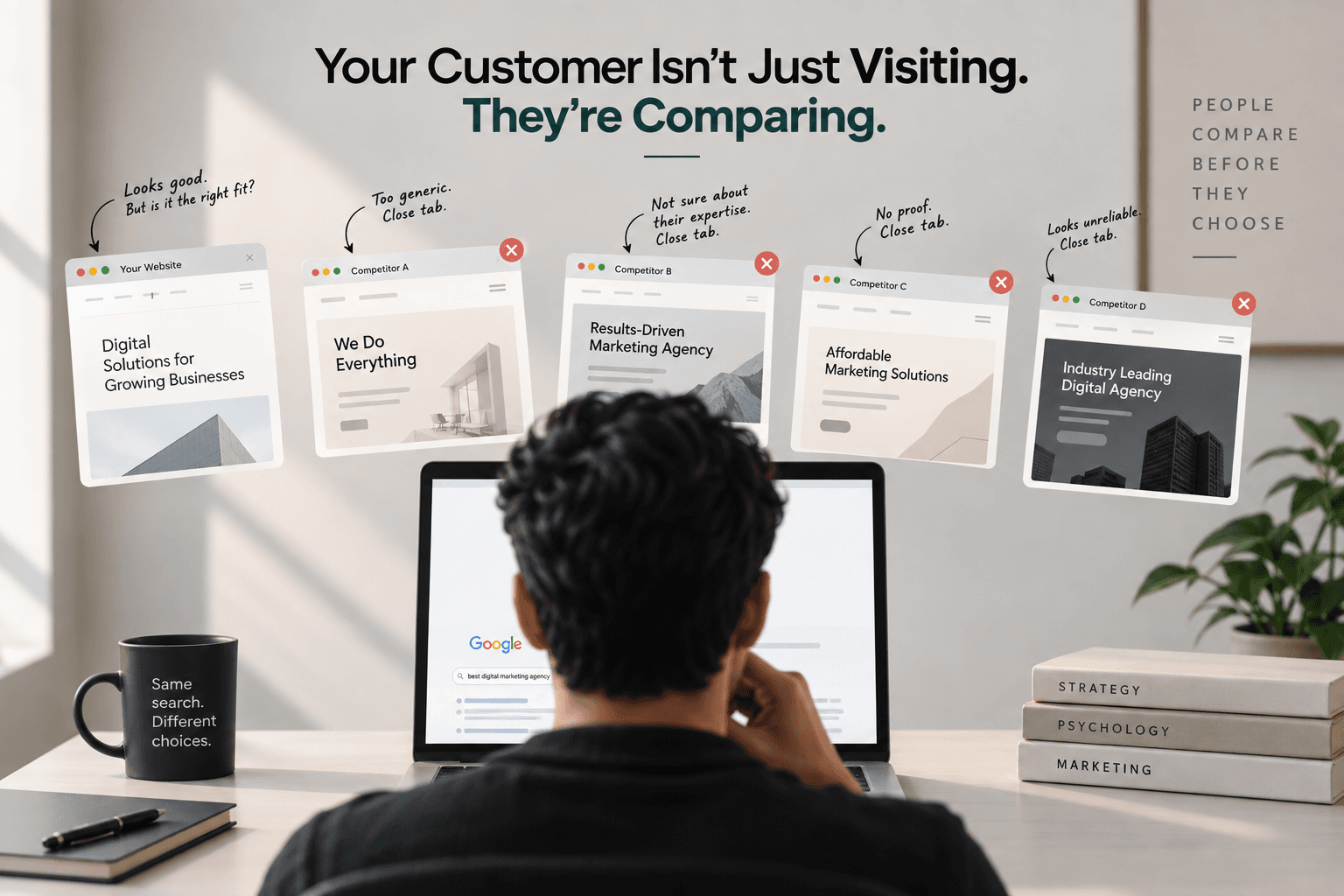
Think About the Five Tabs Your Customer Has Open
Your customer probably isn't visiting your website in isolation.
Suppose a business owner searches for a service on Google.
They open five tabs.
Your company.
Competitor A.
Competitor B.
A marketplace.
Maybe a Reddit thread, review platform or social media profile.
They aren't carefully reading every word on every page. Human patience has somehow survived TikTok, but not by much.
Instead, they're filtering.
“I don't understand exactly what they do.”
Close.
“This looks generic.”
Close.
“I can't find any proof.”
Close.
“I don't know whether they work with companies like mine.”
Close.
Eventually, only a few options remain.
At this stage, traffic has already done its job.
You got the click.
Now the competition is about who survives the customer's elimination process.
The business that wins isn't necessarily the one that attracted the most visitors.
It may simply be the one that created the fewest reasons to leave.
Getting Found and Getting Chosen Are Different Marketing Problems
SEO can help customers find you.
Advertising can put your brand in front of them.
Social media can create awareness.
Content can capture their attention.
But none of those things automatically answers:
“Why should I choose you?”
That requires positioning.
Consider two agencies.
Agency A:
“We are a full-service digital marketing agency providing innovative solutions to help businesses grow.”
Agency B:
“We help healthcare brands turn patient search behaviour into qualified enquiries.”
Agency A might actually provide more services.
But if you run a hospital or healthcare company, Agency B immediately feels more relevant.
That is the power of positioning.
Customers rarely evaluate every capability a company has. They use shortcuts to decide whether a business feels suitable for their particular situation.
The more quickly someone can recognise themselves in your message, the less mental work they need to do.
And businesses that are easier to understand are often easier to choose.
Your Website May Be Talking About the Wrong Person
Open a typical company website and you'll often see:
Who we are.
Our journey.
Our vision.
Our mission.
Our services.
Our experienced team.
None of these things are inherently wrong.
The problem is that your customer didn't arrive thinking about your company.
They arrived thinking about their problem.
A potential SEO client isn't initially wondering:
“How passionate is this agency about digital transformation?”
They're probably wondering:
“Why isn't my website generating enquiries?”
A patient isn't initially interested in a hospital's corporate history.
They're thinking:
“Can this doctor help with my condition?”
Someone hiring a software company may not care about the company's mission statement.
They're wondering:
“Can they actually build this without wasting six months?”
This creates a simple mismatch.
Businesses communicate from their own perspective while customers evaluate from theirs.
Strong competitors reverse that.
Instead of:
Who we are → What we do → Our services → Contact us
they move closer to:
Your problem → Why it happens → What needs to change → How we solve it → Evidence → Next step
One structure asks the visitor to become interested in the company.
The other enters a conversation already happening inside the visitor's head.
Your Competitor May Be Selling Certainty
Most meaningful purchases contain risk.
Choosing a marketing agency.
Hiring a developer.
Selecting a hospital.
Buying property.
Working with an architect.
Hiring a consultant.
Customers usually cannot know exactly what the experience will be like until after they pay.
So before making a decision, they look for signals.
Case studies signal experience.
Testimonials signal previous satisfaction.
Recognisable clients signal credibility.
A clear process signals organisation.
Specific expertise signals competence.
Transparent communication signals confidence.
Consistent branding signals professionalism.
Useful educational content signals knowledge.
Individually, these things may seem small.
Together, they answer one enormous question:
“Can I trust these people?”
This is why writing “We are a trusted company” isn't particularly persuasive.
Trust isn't created because a business declares itself trustworthy.
Trust grows when customers encounter enough evidence to reach that conclusion themselves.
Your competitor may not actually provide a better service.
They may simply make their expertise easier to believe.
Customers Are Looking for Reasons Not to Choose You Too
Businesses naturally focus on giving customers reasons to buy.
Customers often behave differently.
They look for reasons to eliminate risk.
Suppose someone is already interested in your company.
They look for previous projects.
Nothing.
“Have they actually done this before?”
They check pricing.
There is no indication whether your service costs ₹10,000 or ₹10 lakh.
“This could be outside my budget.”
They open Instagram.
The last post is from eight months ago.
“Are they still active?”
They reach your enquiry form.
Twelve mandatory fields appear.
“I'll do this later.”
And “later” joins the enormous digital graveyard containing abandoned carts, unread newsletters and gym memberships purchased in January.
None of these issues proves your company is unreliable.
But customers aren't operating with complete information.
They interpret signals.
Small uncertainties accumulate until choosing another company simply feels safer.
More Persuasion Isn't Always the Answer
When leads are low, businesses often respond by adding more.
More pop-ups.
More offers.
More banners.
More CTAs.
More claims.
Sometimes the better strategy is subtraction.
Remove unnecessary form fields.
Remove vague language.
Remove confusing navigation.
Remove unnecessary steps between interest and enquiry.
Make your phone number obvious.
Make WhatsApp work properly.
Explain what happens after someone submits an enquiry.
Replace mysterious CTAs like “Submit” with something that tells customers what they're actually doing.
Request a Consultation.
Get a Quote.
Discuss Your Project.
Book an Appointment.
When someone has decided to contact you, your website shouldn't suddenly turn into an escape room.
Strong Marketing Answers Questions Before Sales Has To
Consider someone looking for SEO services.
Before contacting an agency, they might wonder:
How long will SEO take?
What will happen during the first month?
What exactly will the agency work on?
Have they worked in my industry?
How are results measured?
Will I receive reports?
What happens if rankings don't improve immediately?
What makes this agency different from the other ten agencies I opened?
If your website doesn't answer these questions, your salesperson inherits all of that uncertainty.
But imagine the visitor has already read:
A detailed service page.
An industry-specific case study.
A realistic explanation of SEO timelines.
An FAQ addressing common concerns.
An article explaining the agency's approach.
A page showing exactly how the engagement works.
Now the sales conversation starts from a completely different place.
The website hasn't merely generated a lead.
It has prepared the lead.
That distinction can have an enormous impact on lead quality.
Being Remembered Matters More Than Most Businesses Think
There is another reason your competitor may generate more enquiries.
People remember them.
Visit ten agency websites and you'll probably encounter some combination of:
“Results-driven.”
“Customer-centric.”
“Innovative.”
“Data-driven.”
“End-to-end solutions.”
“Your trusted growth partner.”
None of these statements is necessarily false.
They're simply difficult to own.
When every business uses the same language, the category becomes a wall of interchangeable claims.
Strong brands give customers something specific to remember.
It could be a specialisation.
A distinctive process.
A particular philosophy.
A recognisable visual identity.
A strong point of view.
A memorable personality.
A clear audience.
A unique methodology.
A specific promise.
If someone encounters Ztrategize today and remembers it three weeks later as:
“That agency focused on customer psychology and decision-making.”
that association has value.
Because customers don't always enquire during the same session in which they discover you.
They may return days or weeks later.
And when that moment comes, the brand that occupies a clear position in memory has an advantage.
Don't Just Compare Traffic. Compare Decision Journeys.
When a competitor generates more leads, the instinct is often to investigate:
What keywords are they ranking for?
How much are they spending on ads?
Where are their backlinks coming from?
How much traffic are they getting?
Those are useful questions.
But they don't tell the entire story.
Also ask:
What can I understand about their business within five seconds?
Who does their website appear to be speaking to?
What proof do they provide?
What customer fears are they addressing?
How clearly do they explain their process?
What makes them different enough to remember?
How easy is it to make an enquiry?
What happens immediately after an enquiry?
What would make a customer feel safer choosing them instead of us?
Now you're no longer analysing only their marketing channels.
You're analysing the customer's decision journey.
That is usually where the more interesting answers appear.
The Real Goal Isn't Maximum Traffic. It's Qualified Preference.
None of this means traffic doesn't matter.
Without visibility, customers cannot discover you.
SEO matters.
Advertising matters.
Content matters.
Social media matters.
But traffic is an opportunity, not an outcome.
If 10,000 people visit your website and leave unconvinced, increasing that number to 20,000 doesn't necessarily solve the underlying problem.
You may simply be doubling the number of people who don't choose you.
The more useful question is:
“When the right customer compares us with our competitors, what makes them prefer us?”
That question changes everything.
It forces you to examine your positioning.
Your messaging.
Your credibility.
Your website experience.
Your proof.
Your brand.
Your customer psychology.
Your conversion journey.
And your sales process.
Suddenly, the competitor getting more leads with less traffic isn't mysterious anymore.
They may not be winning the attention battle.
They're winning the decision.
Ztrategize: Build Marketing Around How Customers Decide
At Ztrategize, we believe marketing shouldn't stop at generating clicks, impressions and website traffic.
The more important question is what happens after someone notices your brand.
By combining psychological branding, consumer behaviour, SEO and digital marketing, Ztrategize helps businesses understand the factors that influence customers to notice, trust, remember and ultimately choose one brand over another.
Because visibility creates the opportunity to be considered.
Preference creates the reason to be chosen.